

SCREEN TIME - Is it really that bad?
YES AND NO

I know in some ways we are probably all sick of hearing about screen-time. But it has been on my mind lately and I want to talk about it.
My screen-time has been shocking. Despite not having TikTok, Instagram or the Facebook app on my phone, I have spent a ridiculous amount of time on my phone. Even using the messenger app to still access Facebook :( and the browser to still access YouTube :(
About a month ago I decided to cut out short-form videos. Short-form videos have been my enemy since they first hit the scene. I wrote about my frustration with every platform adopting them here.
I have never been able to have TikTok because I have a lack of ability to transition out and away from such an immersive platform. Each time a new app added the reels feature I have had to leave. I left Snapchat when they invented the discovery page - wtf even was that? I left Instagram over reels. I deleted the YouTube app after YouTube shorts and I deleted the Facebook app.
But choosing to not watch short form videos is not enough. My screen-time app showed that over the last month I transitioned more and more of that screen-time to Substack. With a weekly average of 24 hours. That is insane!
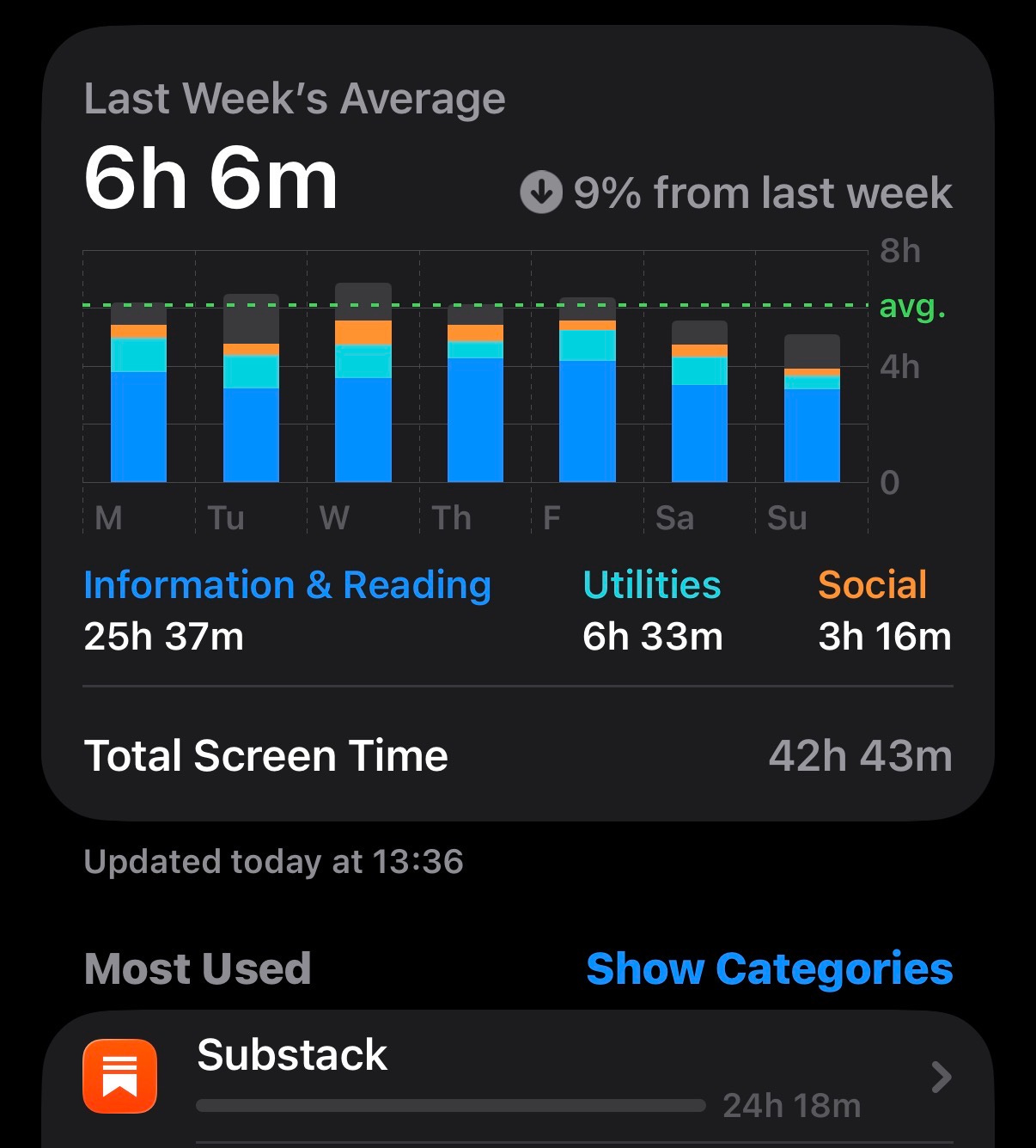
That is a whole 1/7th of my life spent on Substack, it’s a whole day/night cycle. It’s two 12 hour shifts at the Substack notes factory or four 6 hour shifts.
It is too much.
Something has to change, and I can be forgiving and generous to myself and say that I have been relishing in the growing community here, and a little over-excited about the fact that people are finally here responding and talking back to me.
But enough is enough - I want my life back.
The problem
The thing is, though, it is not that easy. It is purposefully designed to be incredibly hard to put your phone down. Reclaiming my life means waging a battle with me on one side, and every tech company and advertiser on the other side.
No wonder we are all constantly losing.
A war is being waged, for our attention, for our lives and for our time. And the opposing side has a lot more resources. It feels like we are losing.
Social media companies are using colours, notifications, infinite scrolls with intermittent reward cycles, video auto-play, emotional manipulation, rage-bait, social validation, manufactured urgency and scarcity, click-bait and the small tiny shred of potential connection with your friends to keep you on their platforms for hours. All those tricks and more. It’s the goddamn pokies in your pocket.
Some people are going to be inherently more susceptible to these manipulative tactics than others. People who already struggle with interruptions, transitions between tasks, lack of validation and depth of emotion. People whose nervous systems are already on high alert survival mode. People who are more governed by impulse.
I don’t think its hyperbole to say that social media by using these tactics is disproportionally negatively impacting some of the most vulnerable people. It is the same with any addiction. If these tactics are designed to work on the average human - how much more successful will they be on someone with executive dysfunction?
A lot.
I have my phone on silent, I have all notifications turned off. That does not stop me from picking up my phone every few minutes to open my favourite apps and refresh the feed and check all those little icons.
There is something about notifications in particular that effs me up.
I have always been the kind of person that feels their presence as a kind of to-do or demand. An open-loop that needs closing. I hate having them sitting there, so I always want to clear them.
Unfortunately this is exactly what the apps want me to do and so they literally invent more notifications just for me to clear, and they even do phantom ones that don’t even exist. Substack is constantly telling me I have a message when I do not. Facebook will invent 7 random notifications just to get me to click on them.
I envy the people with the ability to just let their notifications pile up. I am more of an inbox zero person. Every incoming email gets screened, deleted, left as a to-do or filed away in labelled folders. I just cannot stand having 374959 emails sitting in my inbox. They feel like they are hanging over me.
This is not to give the impression I am organised, I certainly am not in all other digital domains. My desktop is a mess of folders and sticky notes, my documents folder is chaos, my iPhone is full of photos, screenshots and random notes with no home or system and same with the photo app on my laptop. Every now and again I scoop everything off the desktop into an untitled folder and banish it to the void that is my documents folder.
But notifications and emails feel like something I have to do something about. That is how they get ya.
I want to do a little aside here.
Not all screen time is bad.
Screen-time can be regulating, it can be an escape, it can be entertainment and it can be a distraction.
All things that by themselves and depending on the situation are not inherently bad.
Entertainment is not inherently a bad thing. Phone-time may be up, but TV viewing is down, listening to the radio is down, newspaper reading is down, sharing stories over the camp-fire is down.
People have always found ways to entertain themselves. Being “unproductive” is a very modern and capitalism-coded fear.
It’s funny isn’t it that as we spend more and more time on these platforms, producing data and making the tech moguls tonnes of money in advertising views and private data sales we worry we aren’t producing anything. We are, it’s just hidden from us, so it can be sold out from under us.
We are working unpaid full-time jobs at the Meta and Google data factories and they don’t want us to know that so we continue feeling guilt and pressure and working full-time jobs elsewhere as well.
But anyway, back to how not all screen time is bad.
I had the personal realisation lately that some forms of screen time actually help regulate me, they give me a focus and an outlet for energy that otherwise would have nowhere to go. I am talking about playing video games. In an over-stimulated state playing a cosy video game, with tasks and goals to complete and clear rules and structure helps to settle and relax my system.
I recently had the experience of trying to go to sleep early in a wired state, being unable to sleep, getting up and playing one hour of a game and then being able to fall straight to sleep. This experience seems to fly counter to all the narratives we have around screens and sleep. But I suppose my brain also flies counter to all the narratives we have about brains.
So for some people, some screen-time can be regulating. I would say for me, social media is not, because you never know what you are going to get when you open the apps, sometimes you are bombarded immediately with people calling you names, and acting like you are the worst human in the world, worse than Hitler, because they simply misunderstood something you were trying to say.
Other times you open the apps and are immediately met with someone arguing your existence is a lie, or a tragedy or some other hateful thing. For this reason, they are unpredictable and therefore more likely to be nervous system activating for me.
Screen time can also be an escape or a distraction.
I know that new age spirituality would have you believe that escape and distraction are always bad things. That we should aim to always be with what is.
But I disagree. Because sometimes shit is just too painful. Sometimes we need a distraction, when we are not ready to face something emotionally or when the physical pain is just that bad.
As long as we are intentional and we are aware of what we are doing, I don’t think this is always a bad thing.
Distracting yourself from temporary suicidal ideation can be an effective coping strategy. As can distracting yourself from intense physical pain. Or grief.
Distraction and escape can be useful coping tools.
In an overwhelming environment, focusing on just your phone can actually help a highly sensitive nervous system tune out some of the overwhelming factors and get through the situation.
The problem comes with the way we are continuously distracting ourselves unconsciously out of our whole lives because of the predatory engagement techniques of social media companies.
Screen time can even serve as a form of body doubling.
Sometimes for me, putting on a podcast or YouTube video is the difference between being able to initiate cooking, or doing the dishes and not. I think it is a kind of virtual body doubling or dare I say habit stacking. It gives the task enough of a reward incentive for me to be able to start.
Intentional and conscious screen-time is not the enemy.
But our intentional and conscious use of phones and social media, starts to creep into a more unintentional and unconscious habit and pattern of usage that resembles addiction.
Screen time can be social connection
Especially for neurodivergent folk, people who benefit from asynchronous styles of communication. For chronically ill or disabled folk trapped at home, less able to access the community than they would like. Isolated and rural folk. For anyone who is different in some way or has some barrier to finding community locally the internet can be a lifeline.
What can I actually do about my ridiculous screen-time?
I already charge my phone in my living room. I wake up and have time to adjust to being in this waking reality, for my albeit limited executive functioning skills to come online (if they are going to play ball that day) before I am capable of reaching for my phone.
I think this is important, it also stops the late night scrolling that keeps me awake and DOES affect my sleep in a way that video games do not.
I am protecting those two transitional areas of the day - the one where I transition from wakefulness to sleep and the one where I transition back from sleep to wakefulness.
I think in those transition periods we can be most susceptible to acting out of habit, having a lack of willpower, or even just a high need for easy dopamine that can make resisting the phone very very difficult.
I have a very old clock radio alarm in my bedroom for knowing the time and setting the occasional alarm. I tend to go to bed early, with a book or game so that I have time to wind down without a phone or the internet before I go to sleep.
Things I have tried
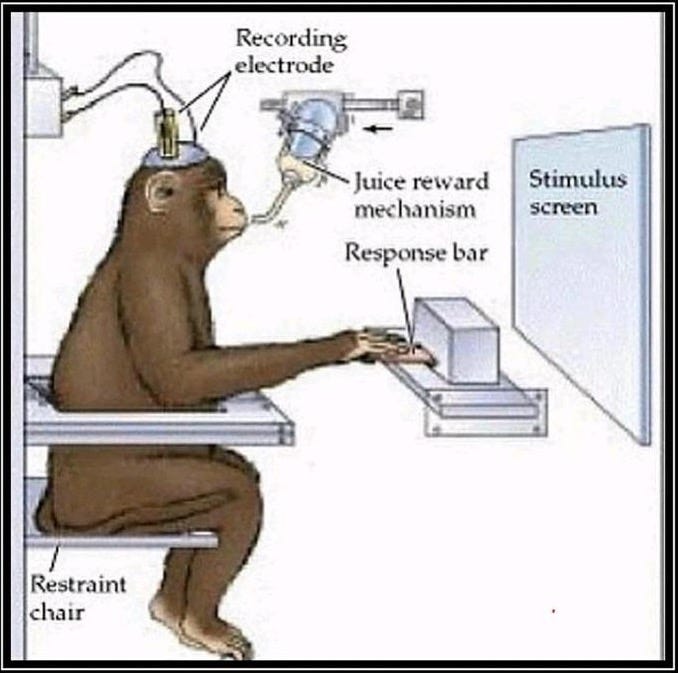
I have tried using the screen time app limits - too easy to get around, too rewarding to keep hitting the 15 minutes more button, and ultimately a big old waste of time. Basically shameful rat pressing lever theatre.
I have tried using a flip phone - but I haven’t found one that can manage wifi calling, so the reception is always shockingly bad - I genuinely can’t even make a phone call which is a problem for a phone. I miss emojis. And I ultimately miss a lot of the functionality of a smart phone that doubles as a camera, wallet, note-taking device, internet messaging device, banking device, GPS and filing system.
I have tried not having social media - I never got TikTok. I deleted Instagram, I deleted Snapchat. I have deactivated Facebook in the past but now I need it for swim club meeting times. Not having it at all is a fairly good move. But so many things use social media and if you want to have any kind of internet based success you basically have to pick your poison.
I have considered buying one of those time-lockable boxes. I can put my phone in and lock it away for a set time. But I am 99% sure there would be a work-around and that it is also low key dangerous for emergency situations.
I have tried using my apple watch, with all notifications and apps removed as a phone substitute for going on walks without taking a phone but still having the ability to emergency call someone. This has never really worked as I feel I end up using tech more rather than less. I do sometimes just leave my phone and watch at home and that is kind of naughty as someone who could have a medical episode lol.
I have been curious about Brick - the premise being that you set up an app to lock you out of your other apps and you can’t physically gain access again until you tap you phone on the physical brick device. The idea is to introduce some physical friction into the process. It’s like the screen-time limits but instead of being able to tap 15 more minutes, you actually have to get up and go to where your device is to unlock the app.
The downside is it is $94 AUD. That is a lot of money for something that may or may not work for me.
What I am trying now
I discovered that there is a free open source app called Foqos that basically works the same way. I think it is only available on iOS but there might be an android alternatives.
You choose which apps are blocked and can set up different profiles for different purposes. I made one called Offline Mode that basically blocks everything. And another called Offline Mode Lite that blocks a few less things, things that I might need to access to if I am out of the house and away from my unlocking device like mail and internet banking.
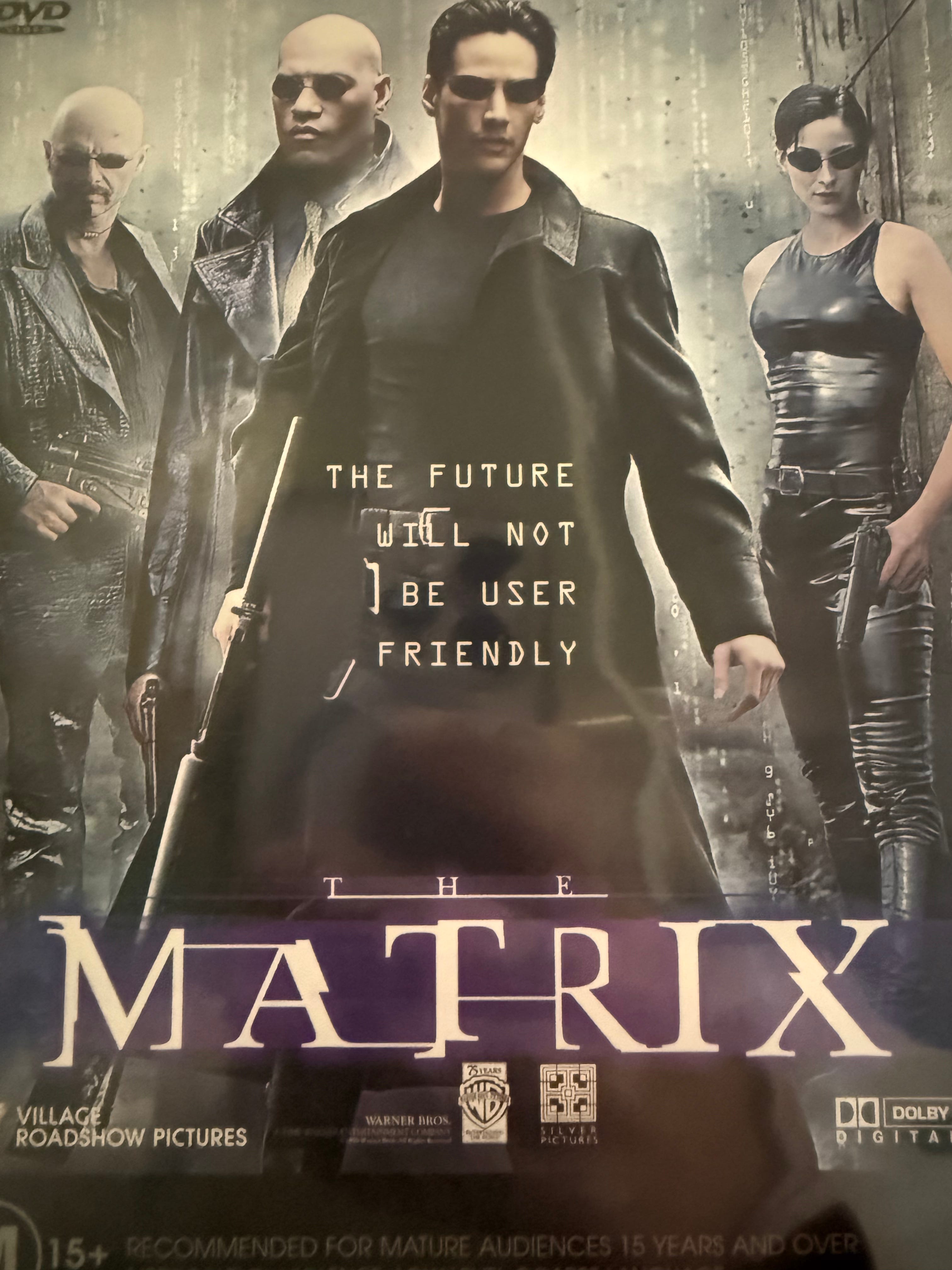
The fun part is you can use any NFC tag, barcode or QR code as your “Brick”, your physical unlocking device. I chose my DVD of The Matrix so every-time I choose to go online by unlocking my phone I have to find this DVD and I am reminded of exactly what I’m heading into.
I’ve been using Foqos for the last couple of days and so far my screen time has gone down from 6 hours a day to 2.5-3. I haven’t even set any goals on how far I want to reduce or what I want to use it for. It has simply gone down that far from requiring me to be more intentional in choosing to use it. From making it just that little bit more difficult for me to access. I keep the phone in Foqos mode and only unlock it when I want to do something in particular.
My phone use has decreased that much just from cutting out the mindless, unintentional parts of my use.
The great thing about Foqos is that you don’t need to go to the physical key to lock your phone. So the second you start thinking “what am I doing? I need to stop.” you can lock yourself out and you won’t be able to get back in until you go to the physical barcode, nfc tag or QR code you set.
What do I want to do instead?
I think the problem with a lot of discourse about phone usage is that it is so steeped in productivity culture. The argument being we should replace our screen time with a productive activity.
I think that misses the point. It misses why we are turning to our phones. It increases shame which only leads to more escapism and more phone usage.
We are scrolling when we are tired. When we are overwhelmed. When another activity feels too hard to start. When we are “relaxing” or “taking a break”. Despite the evidence and lived reality that scrolling often doesn’t feel restful or relaxing. We are using our phones when we are depleted in some way.
When we try to replace this screen time it might be more helpful, instead of thinking of productive things to do, to think of restful things to do.
I posted a note recently to get suggestions and there are a bunch there, check them out:
Some of my favourite suggestions were:
I play Graveyard Keeper on Nintendo Switch! But I was so tempted by this game it might be my next pick.
I too love the show + hands occupied activity and often knit in front of the TV.
Origami is another great “hands occupied” activity.
There are heaps more great suggestions including bird watching from the window or in the garden, doing absolutely nothing, flicking through physical magazines or books.
The point is that we need to be matching the activity to our drive and our capacity. Why are we turning to our phones? In what moods, states or situations? And what would be an EASY swap, the EASIEST swap.
Not, how can I take this time and run a multi-million dollar business, or write a new best seller. This is not the time for that kind of activity and we know that. If we put that pressure on the time we will just turn back to the phones.
I for one, want to spend more time doing nothing and more time reading actual books. I want to spend more time watching long form videos, TV shows and movies without looking at my phone at the same time and missing most of it. I want to play Graveyard Keeper because despite how “unproductive” it is, I still feel better after having fun there than I do after scrolling.
I want a brain that doesn’t feel hijacked by information overload. I want quiet. I want peace. I want to be able to hear myself think. I want to be poised, waiting for insight that comes from within rather than from out there.
I want to be more offline.
The role of community.
If this is a war being waged, and we are vastly outnumbered, how do we turn the tables?
We need to band together.
I am worried about my parents. They are in their late fifties and more and more I see them scrolling for hours and scrolling reels. They don’t seem to see a problem with it. They don’t seem to see how much it has overtaken their free-time.

I spend time with my brother and he is constantly watching reels at the same time we are supposed to be talking and hanging out. I get second-hand overload from the sound and video coming from his phone. He often doesn’t even watch the videos, he is just flicking through moving image after moving image.
Culturally we need to shift the narrative. We need to make it embarrassing, make it a faux pas to pull out a phone in company. Make it rude.
We need to open phone-free spaces; cafes, book-stores, clubs, any place where phones get checked in upon entry and returned on exit.
Instead of internet cafes we need internet free cafes.
We need to revitalise phone-free entertainment: theatre, community story evenings where everyone can speak.
Any group can become a phone-free group.
I am tempted to put up some flyers and start an attentional based group in my local area. I want a group where we just sit together in silence and watch the ocean and the birds. No phones, minimal talking. Just watching.
In the space these phones leave behind, what will we find?
Will it be each other? Will it be peace? Will it be your next best idea?
There is only one way we can all find out. And I am committed to continually trying. If this is a losing war, I will not go down easy.
I loved this piece but my favorite part by far was the matrix. Ultimate hack.
This was really good. I need to rein in my Substack time. Might try that phone locking app you suggested. And the Matrix hack is genius!