

What actually is the problem with working for autistic people?
It's the problems with working PERIODT.

I made a digital zine called Fragments of Desire. It’s a short collection of original poetry with some original artwork, absolutely no AI involved in any step in the process and it’s available on my Kofi shop now! All proceeds go towards a more suitable bed for me and it’s pay what you want on a sliding scale starting from $4 AUD. Check it out here!
Whenever I try to articulate the issues I have with work as an autistic person, it always sounds like a list of things that MOST people have trouble with.
Micromanaging bosses, passive aggressive communication, bullshit hierarchies, having to set an alarm to wake up at a non-natural time, not being able to do anything else, having to work on things that are not interesting, with people you don’t like, long hours, difficulty maintaining a social life, health and fitness or hobbies, unnatural lighting and working environments, interruptions, social politics and games that are somehow more important than the work itself.
And most people’s response is so what?
How is that different to anyone else?
This is the part where most people judge me as lazy, a spoiled princess or some other horrible stereotype.
This is the part where they assume I don’t “want” to work, that I have no work ethic.
Despite the evidence that I work quite hard at things that are important to me - like surviving, physiotherapy, maintaining some semblance of physical fitness and writing.
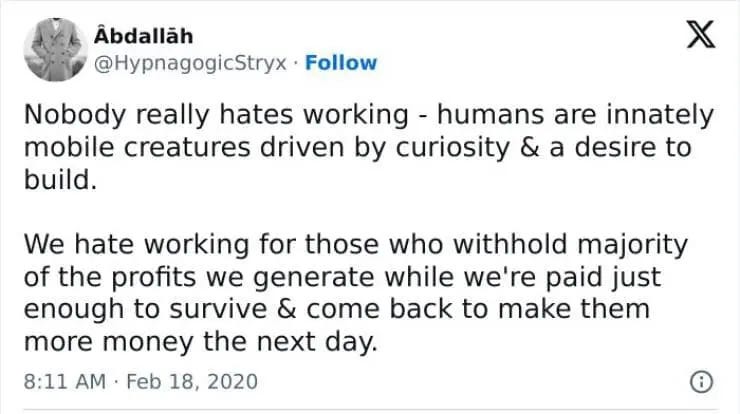
People judge me this way because most people don’t want to work. Most people struggle with these things and most people hate these aspects of their working lives. They see me as “getting away with” not working, something they would like to do and something they are probably a little bit jealous of.
Despite the fact that my life without work in it probably amounts to the same or less free-time than they have while working, because I am managing multiple health conditions and disabilities.
Despite the fact they say they could never “afford to” do what I do - I wonder how they think I afford anything… because I don’t.
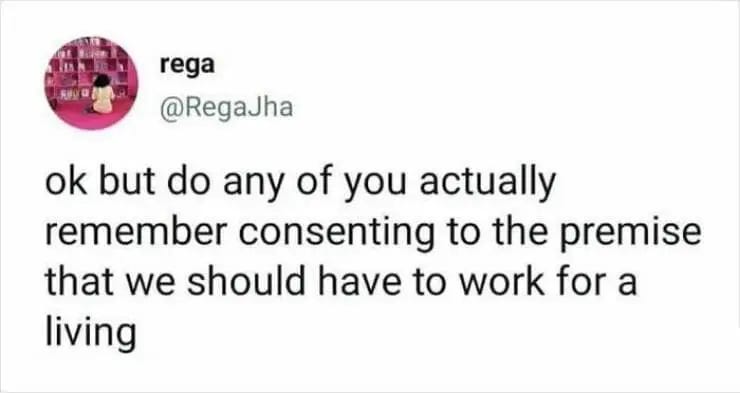
But the implication in these conversations about the things most people struggle with about work is that most people JUST do it anyway. Because they need money.
But that “JUST” is carrying a lot of weight in that sentence. Because what does “JUST” mean in this context?
It means having a brain and body that allows them to smoothly and seamlessly override their internal and physical experience in service of their goal (making money) with very little mental or physical resistance or consequences.
I do not have a system that works like that. I do not have that neurology. I do not have that physical body.
For every single item on that list, from the very first - an alarm going off in the morning, to having to be somewhere at a set-time, to having to be in an uncomfortable environment working on uninteresting work and being unable to do anything afterwards - each item has a very large cost for my energy and my nervous system.
Take setting an alarm for example - I can set an alarm to wake up earlier than my natural wake-up time sometimes, but the more I do this, the more often, day after day, a load accumulates. There will come a day when this alone is enough to make me so sick and unwell that I cannot continue and must take a day off.
At the moment my threshold for this is very low - one early wake-up is enough to have a price to pay. But even when I was able to work part-time this was something I struggled with in the course of a working week. Enough interruptions to my natural sleep patterns and I will pay a physiological toll.
I think to some degree this physical cost exists for everyone. But I think other bodies may have an easier time adjusting to a different sleep schedule, they get “used to it” in a way my system never does. The same with office lighting, and all the other things I mentioned.
I think these are very real problems with real and documented effects on ALL human bodies.
My system is like a very intense juggling act.
There is essentially so much going on with my nervous system, mood, neurology and physiology at a baseline level that a small trigger like an alarm clock going off early can cause a flow on effect that destabilises and unbalances the whole precarious system and everything come crashing down.
Pre-diagnosis I used to complain to my loved ones: “Why does it seem like I have to do absolutely everything perfectly just to take care of myself and be ok, when other people get away with doing nothing?”
I was referring to my need to get enough sleep, healthy food, hydration, avoid alcohol, go outside, breathe fresh air, engage in mindfulness and hobbies. If I let any of these things slip I would very quickly not be ok.
I felt like a very complicated to maintain machine. A very finely tuned instrument - something that has great capacity for sensitivity and specificity but is also greatly affected by even the smallest change.
There are probably some aspects of my difficulty with work that are unique to me. But I think more often than not, the things I struggle with are the things that are damaging to all people.
I just seem to pay a higher physiological and mental cost. A cost so high my body is now failing to be able to pay it. I can no longer override what my system is telling me.
This is why they refer to autistic people as the canary in the coal mine.
But let’s time travel back to some of my experiences with work when I was able to “push-through”.
My first job after university was miraculously a work from home role. In pre-covid days! Mind-boggling. I think this is the one reason I managed a “full-time” load. Because I was only really working 4-5 hours a day, I just had my laptop switched on for 8. I was able to be physically comfortable in my own home, and mostly work independently writing reports so I could be neurologically calm as well - no performance/masking needed. My boss was quite good, and did not micromanage me.
Despite all these factors I still lasted only 8 months. Aspects of this job still took a toll - having to be awake and at my desk at certain times, having to “look like” I was working even when I was not.
Never being able to fully switch off, meant not being able to focus on other things during the set eight hour work day. I couldn’t dive into my hobbies or hyperfixations when I had the “look like I’m working” script running in the background.
I constantly felt like I was faking or lying for not working at full pace and intensity for eight hours straight - despite the fact that when I worked the same role in an office setting I got even less work done because people kept talking to me about unrelated crap or offering me morning tea, or clothes to try on and generally NOT WORKING.
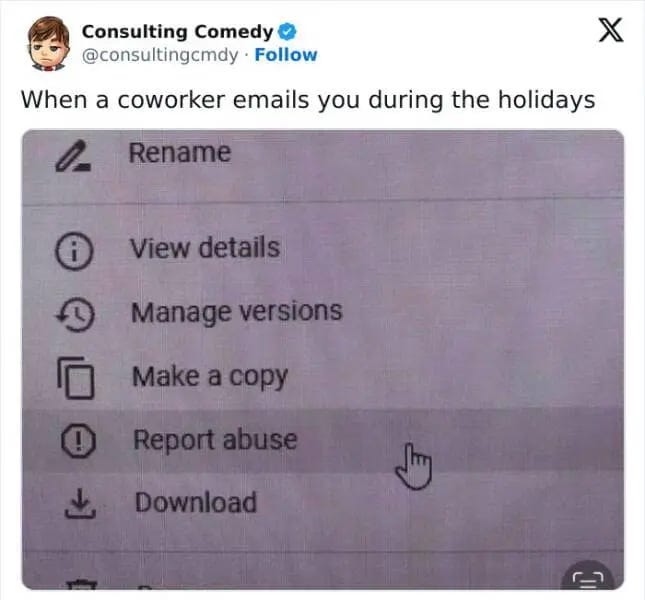
I was still feeling the toll of a full-time load, trying to squish hobbies, fitness and a social life in the hours surrounding it. The difference for me was that by the end of the working day I had no energy left for any of that. I would usually have a migraine and be completely wiped out in bed.
I said to myself and my family, “If all you can do in a day is work, and then you are completely physically and mentally destroyed, then you have to really love that work or it is simply not worth it.” My mental health took a nose-dive as I was unable to do any of the things that make a human being feel like life is worth living. My life was sleep, work, pain, sleep.
Work took everything I had, with nothing left for myself.
This was the start of the pattern of cycling through job failures and burnout. I blamed the job, rather than the condition of work, thinking that if I found a more suitable job or one that I enjoyed more that I would have less problems.
I tried part-time jobs thinking I would have more free-time to pursue other interests or have a life, only to find that no matter how few hours I worked, the physiological toll was the same. The stress of working would often balloon out to eat up all my free time anyway with ruminating or recovering.
I returned to study to find better jobs, completing courses, but upon entering the industry finding that I kept running into the same problems.
The real kicker came when I found a job that I actually enjoyed. I pushed myself out of my comfort zone, convinced that my issues with work were to be found in applying for the same kinds of roles that felt “safe” to me. I decided to go for something that was interesting to me, had potential to be outdoors, but was a little “scary” or made me feel very unsure about what was expected of me.
I became a swim teacher. It felt like a huge deal to me to enter such a different industry and to take responsibility over the lives of children and the skills they were learning. I absolutely loved this role and working with the kids.
Yet I still was not able to sustain it, even in the end, working only two hours a day because the sensory, social and physiological load was still too high. I called in sick, cancelled teaching appointments and still reached a point of burnout.
What I have come to understand is that there was never going to be a job that did not give me difficulty. Because the difficulty I experience working comes from the condition of it being work. Even in roles where my disability is declared.
I have had way more success in volunteer roles; because volunteers are treated with more basic flexibility and respect. They have more autonomy and more control and can adapt their contributions to their own needs. I see no reason, other than the obvious one of controlling the masses, as to why we can’t structure work like this.

The very nature of a working culture that says you must submit yourself to conditions including set hours, set environments, set teams and set hierarchies was always going to generate a physiological and nervous system stress load that is far too high for my complicated system to maintain, no matter the hours.
In fact, working part-time was often worse because I still spent ALL of my time worrying about work, planning what to say or recovering. I felt like I was working full-time but receiving a half-salary.
There are no real clear delineations with work and leisure time. People who work part-time hours often have the same number of “effective work” hours but simply receive less pay for it.
Current work culture is built to compensate “presenteeism” over contribution. If someone is able to be in office and visible for longer - they will get paid more, regardless of what they actually contribute. And if you are unable to be in office, or seen to be working for long hours, then good luck getting any compensation even if you contribute the best work in the whole team.
This rewards people who are naturally social and naturally able to override all the physical and mental stressors of the modern workplace and lifestyle. The very people who flit around the office chatting all day and never seem to get any work done.
These are the very same people in the comments sections telling people like me that it is not “punishment” to be expected to be at your work for your set hours. But for people like me it is.
Physically & Mentally.
But also it is punishment by performance, because I get more work done in two good hours than the office social butterfly does in a week. But rather than acknowledging the ways we work differently and experience time differently and paying us for our contributions, we are paid on attendance - something that overwhelmingly disadvantages disabled people.
We can’t switch our brains off after work either - a solution to a work problem may come in the shower when we aren’t being paid. Yet we aren’t allowed to bill for those insights.
I’ve had dreams where I’ve woken up, written down the solution to a complicated computer programming problem, and then been able to fix the work first thing in the morning.
That contribution is not captured or compensated as “working” in the current ideology of work.
Unfortunately my system is more suited to work without the conditions. I am able to post regularly on Substack for example, because I have no set topics, no boss to appease, no set hours or times to write. The ideas I have in the shower, before bed or even in dreams can all be wrapped up into my contribution to the world. I can write what I want, when I want from the comfort of my own home and schedule posts in advance so if I am unwell for an extended period I don’t have to do anything and the posts keep coming out.
And I just realised I wrote this whole post without even mentioning ableism and the lack of accomodations and understanding. Because this shit runs so much deeper than ear plugs, tinted lenses and a semi-understanding manager. It’s baked into the system.
I’d love to hear your thoughts on working in the comments, how has it worked or not worked for you?
And if you have enjoyed this post please consider tipping me a coffee, a girl’s gotta make some money somehow 😂
I feel this so much!
I never lasted anywhere until I became a dog trainer. Come in in the afternoon. Teach dogs.Go home 4.5 hours later. Base pay plus commissions = full time pay. Lasted 11 years.
I got forced out last year. I've been working with various after school programs since.
Last month I had to accept a role teaching summer school cooking classes (my regular company wasn't offering summer programs in my area). I had to get up at 5:30 a.m. 5 days the 1st week, 4 days the 2nd week. On the last day, I started feeling sick.
That was June 18th. I got progressively sicker for 3 days. I'm just now getting really better. People say, "Just get up earlier. " I can't. It makes me sick.
I've played it off as not being a morning person. But it's more.
The fluorescent lights give me migraines. The radios scramble my thoughts every time they squawk or blat. Some perfume makes it so I can't breathe.
The smell of the breakroom gags me, and I can't eat.
You know.
loved all of this!
i couldn't last longer than 6 months at any job without burning out until i started doing part-time, fully remote, with flexible hours. one day a week is working for me right now but it's not ideal financially
it's only when i started working less that i realised how much energy it takes me to do all the "everyday" things like shopping/cooking/excercise/cleaning etc. the stuff other people see as background tasks already feels like a full time job to me
+ i think the idea of working feels extra bad because i'm hyper aware of how meaningless a lot of jobs are so i don't even get the good feelings of "well at least i'm a good citizen! i'm contributing to society!" and instead just feel like i'm going crazy